
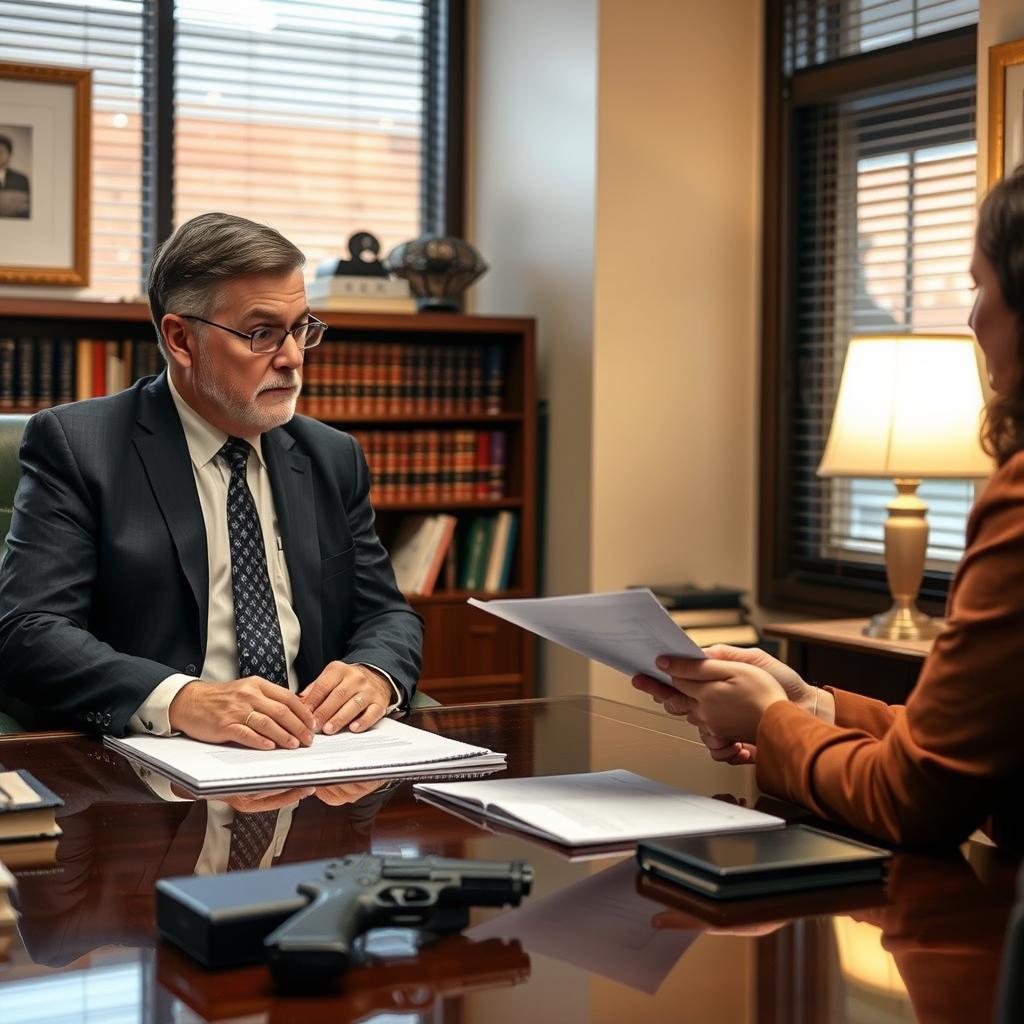
Facing Federal Charges for Using a Firearm in a Violent Crime in Chesapeake, VA?
You were in your Chesapeake neighborhood when a verbal dispute turned physical. Now federal agents are at your door. The U.S. Attorney’s Office for the Eastern District of Virginia has charged you under 18 U.S.C. § 924(c) — use of a firearm in a crime of violence. You’re facing mandatory minimum prison time that runs consecutively to any other sentence. The federal system has no parole, and conviction rates exceed 90 %. You need an attorney who understands how these charges are built and prosecuted in the Norfolk and Newport News divisions. Call Law Offices Of SRIS, P.C. Today at (888) 437‑7747 for a consultation.
What a Defense Strategy Looks Like for a Federal Firearm Charge
When the government charges you under 18 U.S.C. § 924(c), the case often turns on two questions: Was the underlying offense a “crime of violence,” and did you actually use or carry the firearm “during and in relation to” that offense? A defense strategy starts by scrutinizing the government’s evidence — police reports, witness statements, forensic analysis, and the indictment itself. Mr. Sris and his Of Counsel team examine whether the underlying offense qualifies under the Supreme Court’s evolving definition of “crime of violence,” because if it doesn’t, the 924(c) count may be dismissed. They also challenge the connection between the firearm and the alleged crime. Was the weapon merely present, or was it actively employed? Weak causation evidence can undermine the charge. Negotiation with the U.S. Attorney’s Office is also a key path; in the Eastern District of Virginia, prosecutors may be open to a plea to a lesser included offense when the facts and the law support it.
What to Expect in the Federal Process — Eastern District of Virginia
Federal firearm cases move differently from state court, and the stakes are higher. After an arrest, you’ll appear before a U.S. Magistrate Judge, typically in the Norfolk or Newport News courthouse. At an initial appearance, the judge informs you of the charges and sets conditions for pretrial release. A detention hearing follows — federal law often presumes detention in firearm cases, so a strong argument for release is critical. A grand jury must indict you for felony charges; defense counsel can be present during the proceedings to protect your rights. After indictment, the case moves to a U.S. District Judge. Discovery, motion practice, and, if needed, trial all happen under the Federal Rules of Criminal Procedure. Sentencing is governed by the U.S. Sentencing Guidelines, which calculate a guideline range based on the offense level and criminal history. The judge retains discretion after Booker, but mandatory minimums set a floor. The Eastern District of Virginia is known for its “rocket docket,” so timelines can be compressed. Having counsel who knows the local rules and the preferences of the Assistant U.S. Attorneys who handle violent‑crime cases is essential.
Penalties You Face — A Narrative Overview
A conviction for using a firearm during a crime of violence carries severe consequences. Under the applicable statute, the law mandates a minimum term of imprisonment that must be served consecutively to any sentence for the underlying offense. This means that even a short sentence for the primary crime can become a lengthy prison term once the firearm count is added. There is no parole in the federal system, so you will serve the vast majority of your sentence. Good‑time credits are limited. Fines, supervised release, and restitution may also apply. The actual exposure depends on factors including the nature of the underlying crime, whether the firearm was discharged, and any prior criminal history. Because the stakes are this high, mounting a thorough defense from the very beginning is critical. For a detailed statutory analysis of federal firearm charges, see our comprehensive overview on srislawyer.com.
Mr. Sris and His Of Counsel — Experience You Can Rely On
Mr. Sris, Owner and Founder of Law Offices Of SRIS, P.C., is a former prosecutor who has built a multi‑state practice since 1997. He understands how the government builds 924(c) cases because he has seen them from the other side. The firm’s Of Counsel team includes attorneys with deep federal criminal experience. Together, Mr. Sris and his Of Counsel bring extensive combined legal experience in federal firearm defense. Results may vary. When you work with the firm, you gain a defense grounded in knowledge of the Eastern District of Virginia, the U.S. Attorney’s Office, and the sentencing guidelines that control your outcome. The phones are answered 24 hours a day, 365 days a year. Call (888) 437‑7747 to schedule a consultation.
Frequently Asked Questions
What is a “crime of violence” under federal law?
A “crime of violence” is an offense that has as an element the use, attempted use, or threatened use of physical force against the person or property of another — or, under the residual clause, a felony that by its nature involves a substantial risk that physical force may be used. Courts continue to refine that definition after recent Supreme Court decisions, and whether a specific charged offense qualifies can be a central issue in your case.
What should I do if federal agents contact me about a firearm charge?
You have the right to remain silent. Use it. Do not answer questions, give a statement, or consent to a search without a lawyer present. Anything you say can be used against you in federal court. Contact an experienced federal defense attorney immediately. Early intervention can shape the entire direction of the case.
Where will my case be heard if I’m arrested in Chesapeake?
Federal prosecutions arising in Chesapeake fall within the Eastern District of Virginia. The Norfolk Division, located at 600 Granby Street, Norfolk, VA 23510, handles many Hampton Roads cases. The Newport News Division also hears matters from the region. Your initial appearance and detention hearing will typically occur before a U.S. Magistrate Judge in one of these courthouses.
Can I be released on bond while my case is pending?
Federal law imposes a presumption of detention in cases involving a firearm offense that carries a potential penalty of ten years or more. A detention hearing will be held, and your attorney can present evidence that you are not a flight risk or a danger to the community. Specific conditions — such as home confinement with electronic monitoring, a third‑party custodian, or a substantial property bond — may overcome the presumption. Each case is fact‑specific, and early preparation by counsel makes a significant difference.
What does the prosecutor have to prove for a 924(c) conviction?
The government must prove beyond a reasonable doubt that (1) you committed a crime of violence or a drug trafficking crime, and (2) you knowingly used, carried, or possessed a firearm during and in relation to that crime. The “during and in relation to” prong requires more than mere presence of the weapon; it must have facilitated the offense. Challenging this element is a core defense strategy.
Does a 924(c) sentence run at the same time as my other sentences?
No. A conviction under 18 U.S.C. § 924(c) requires a sentence that runs consecutively — in addition to, not concurrent with — any other term of imprisonment you receive. This can add a significant number of years to your overall time in custody. Understanding this structure is essential when considering plea offers or evaluating trial risk.
How is sentencing calculated in federal court?
Federal sentencing begins with the U.S. Sentencing Guidelines, which produce a range based on the offense level and your criminal history category. The guideline for a firearm‑in‑connection‑with‑a‑crime‑of‑violence offense often includes multiple enhancements. After Booker, the guidelines are advisory, but the judge must consider them. Mandatory minimums, however, are binding and trumps any guideline range that would result in a lower sentence. A thorough knowledge of these mechanics is essential for evaluating a case.
What makes the Eastern District of Virginia different from other federal courts?
The “EDVA” is often called the rocket docket because cases move quickly from indictment to trial. The U.S. Attorney’s Office in this district has a high conviction rate and is known for active prosecution, particularly in firearm and violent‑crime cases. Defense counsel must be prepared to litigate motions on a compressed schedule and to engage in meaningful plea negotiations early in the process. Familiarity with the preferences of the sitting district judges and the AUSAs who staff the violent‑crime unit is a valuable perspective.
Do I need a lawyer if I think I’m innocent?
Yes, and especially in federal court. The federal system is complex, and the government will be represented by an experienced prosecutor with substantial resources. Even if you believe the facts exonerate you, you need counsel to frame those facts within the legal elements of the offense, to navigate pretrial procedure, and to potentially file motions to suppress evidence or challenge the indictment. Attempting to explain your way out of an investigation without a lawyer is a dangerous course.
How do I choose the right federal defense attorney for my case?
Look for an attorney with specific federal court experience, knowledge of the Eastern District of Virginia, and a track record of handling firearm‑related offenses. The lawyer should be comfortable with the sentencing guidelines, the local rules, and the prosecution strategies common in the district. A consultation allows you to assess whether the attorney’s approach and communication style match your needs.
Take the Next Step — Call (888) 437‑7747
When you are facing a federal firearm charge, every decision matters. Mr. Sris and his Of Counsel team are available to discuss your situation and outline your legal options. Reach our firm at (888) 437‑7747 to schedule a consultation. Phones are answered during business hours. We serve clients throughout Chesapeake, Deep Creek, Great Bridge, Greenbrier, and all of Hampton Roads.
Richmond Location
7400 Beaufont Springs Drive, Suite 300, Room 395
Richmond, VA 23225
By appointment only. Call (888) 437‑7747.
Additional federal defense resources:
Attorney advertising. Prior results do not guarantee a similar outcome. Results may vary. Case results depend on a variety of factors unique to each case.